 Scrape Scraping
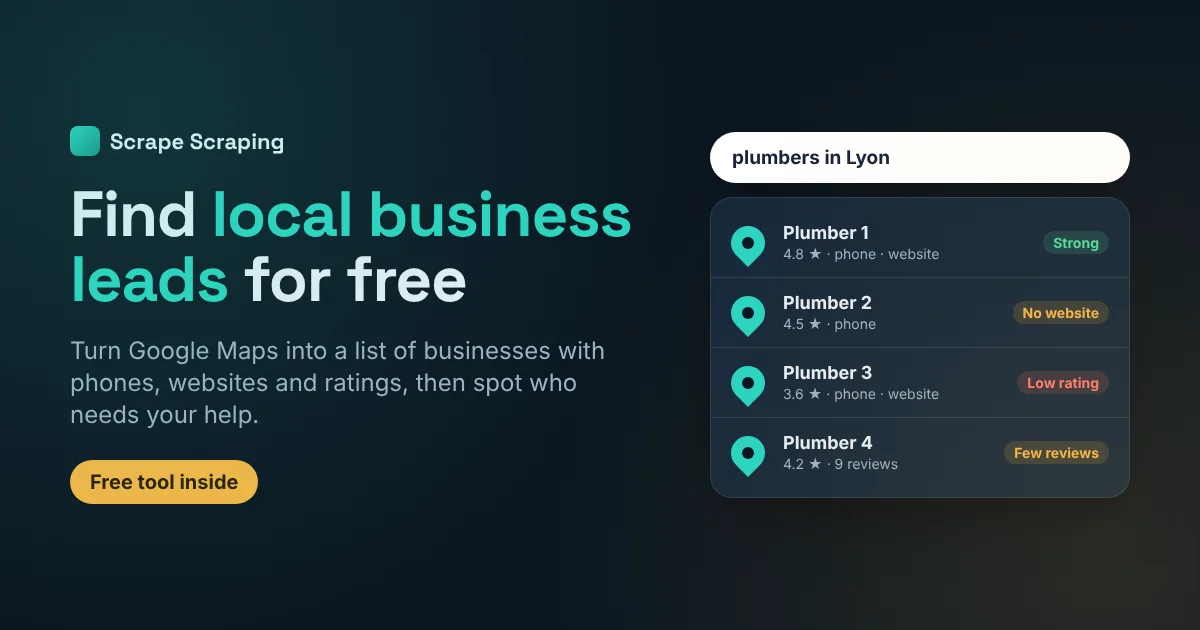
If you sell to local businesses, like web design, SEO, marketing, bookkeeping or software, finding local business leads is the first job of every week. Most people do it the slow way: search Google Maps, open each listing, copy the phone number into a spreadsheet, and repeat.
This guide shows a faster way to build a list of local leads for free, and, more importantly, how to read each listing to see what that business probably needs. That's what turns a list of names into conversations.
Key takeaways
- Google Maps is the best free source of local business leads: name, phone, website, address and rating.
- What a listing is missing (no website, low rating, few reviews) tells you what to offer.
- The free Local Lead Finder turns a search like "plumbers in Lyon" into a ready-to-use list in about a minute.
Why Google Maps is the best source of local leads
Almost every local business has a Google Maps listing, because that's how customers find them. And each listing already contains what you need to start a conversation:
- Business name and category, so you know exactly who you're talking to
- Phone number, often the fastest way to reach the owner
- Website, or the lack of one, which is a lead signal in itself
- Address, useful for local campaigns and in-person visits
- Rating and number of reviews, which show how the business is perceived
Paid lead databases often have outdated information about small local businesses. Google Maps is updated by the businesses themselves and by their customers, so it's usually fresher. If you want the technical background on collecting this data, read our guide on how to extract data from Google Maps.
Read the signals: what each business needs
A list of 100 businesses is just a list. What makes it valuable is knowing which of them actually need what you sell. The good news: a Google Maps listing tells you a lot.
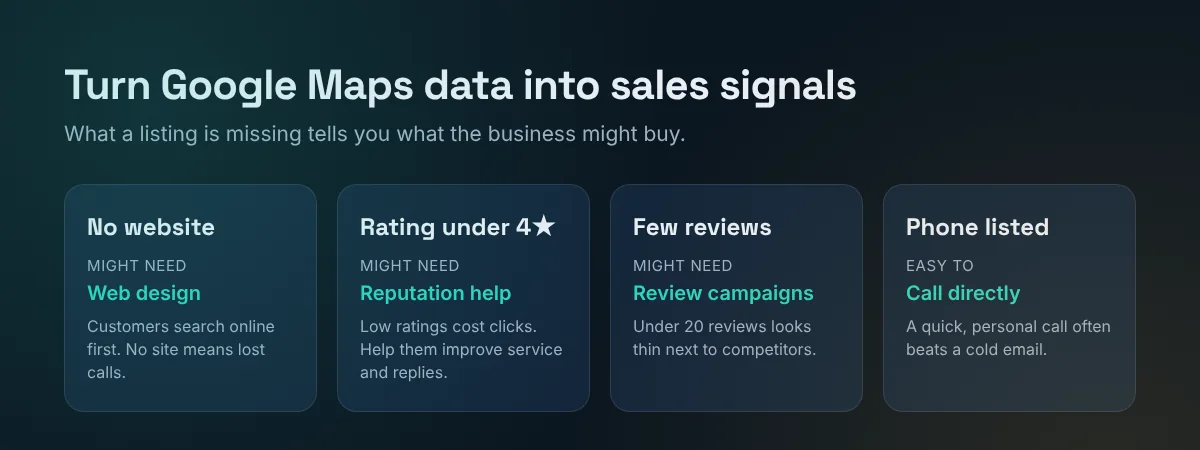
- No website: the business depends on its Maps listing alone. Customers who want to see prices, photos or services can't. That's a clear opening for web designers.
- Rating under 4 stars: people compare ratings before calling. A business at 3.6 stars loses customers to one at 4.6. That's an opening for reputation management, customer service training or review response services.
- Few reviews: a business with 9 reviews looks small next to a competitor with 200, even if its service is better. That's an opening for review collection campaigns and local SEO.
- Phone listed: almost every local business shows a phone number. A short, personal call is often more effective than a cold email, and it's faster to qualify.
A real example: plumbers in Lyon
To show how this works, we searched for "plumbers" in "Lyon, France" with the free tool in November 2026. Here's what the first 10 results looked like.
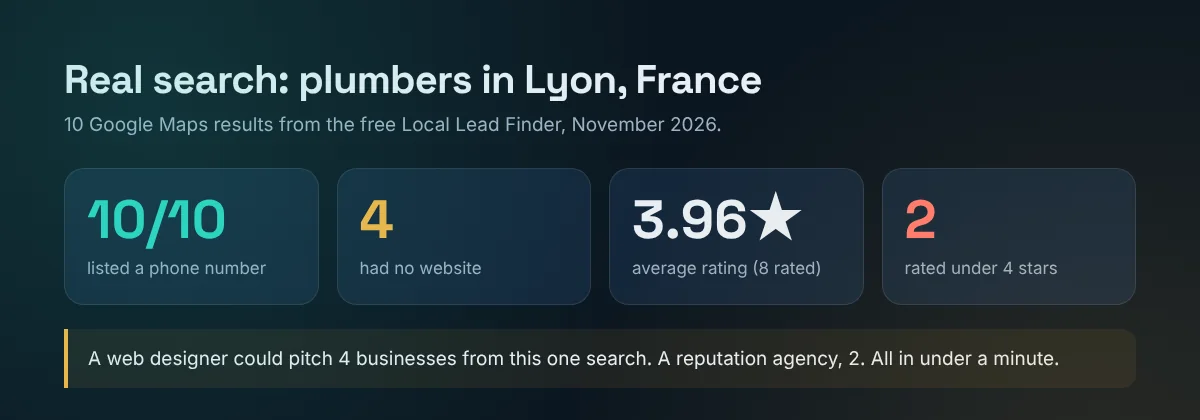
- All 10 businesses listed a phone number.
- 4 of 10 had no website. That's 4 potential clients for a web designer from a single search.
- The average rating was 3.96 stars across the 8 rated businesses, and 2 were rated under 4 stars.
- The results also included a general contractor and two plumbing supply stores. Google Maps mixes related categories in, so always check the category column before contacting anyone.
One search, under a minute, and you already know who to call first and what to say.
Step by step with the free Local Lead Finder
1. Choose a niche and a city
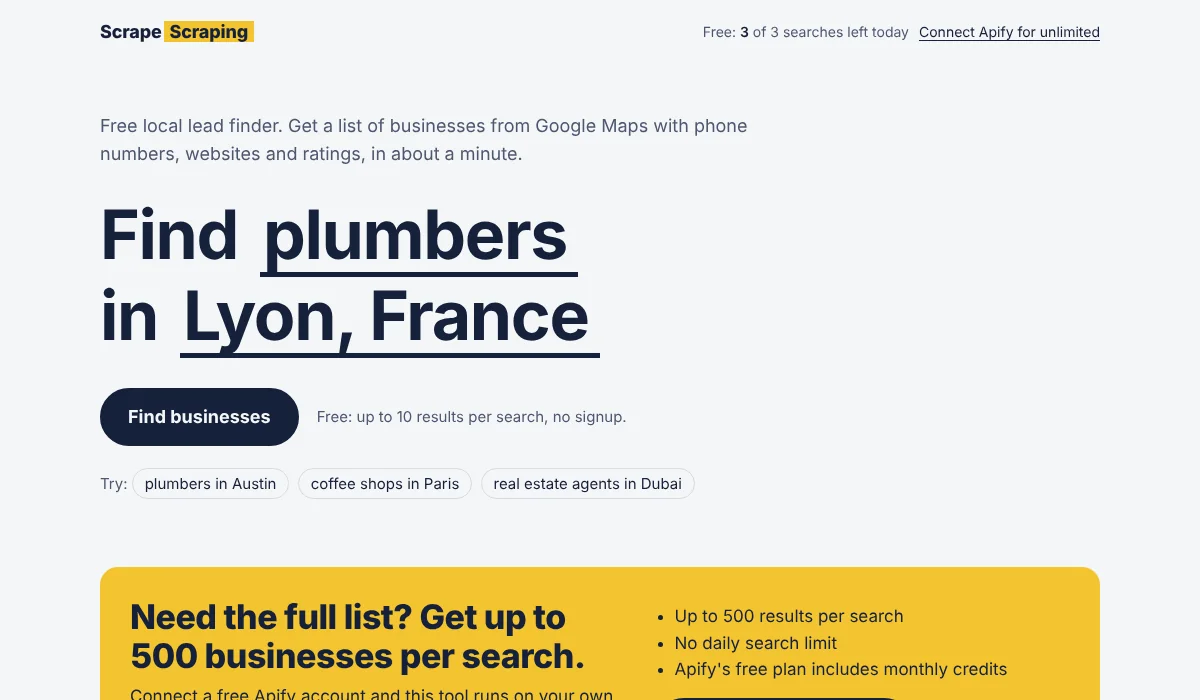
Open the Local Lead Finder and fill in the sentence: "Find dentists in Lyon, France". Be specific. "Italian restaurants" gives better leads than "restaurants", and a city works better than a whole country.
2. Run the search
Click Find businesses. The tool searches Google Maps and returns each business with its category, address, phone, website, rating and review count, usually in under a minute.
3. Download the list
Click Download CSV to get a spreadsheet you can open in Excel or Google Sheets, or import into your CRM.
4. Go bigger when you need to
Free searches show up to 10 businesses, which is perfect for testing a niche. When you're ready for a full list, connect a free Apify account and get up to 500 businesses per search, running on your own account.
Try the free Local Lead Finder
How to qualify your list
Before you contact anyone, spend ten minutes cleaning the list. It saves hours later.
- Check the category. Remove businesses that don't fit, like the supply stores in our plumber example.
- Sort by your signal. Web designer? Put "no website" at the top. Reputation agency? Sort by rating, lowest first.
- Look at the listing. Open the Google Maps link for your top 10. Recent negative reviews, outdated photos or missing opening hours give you something specific to talk about.
- Remove duplicates. Chains and businesses with several listings can appear twice. The free LeadFix Toolkit cleans duplicate rows and formatting problems in your CSV right in the browser.
- Prioritize. Pick 10 to 20 businesses to contact this week. A short, personal list beats a long, generic one.
How to contact local businesses
Local business owners are busy and get a lot of sales calls. The ones that work have three things in common: they're short, specific, and useful.
- Lead with what you noticed. "I saw you don't have a website, and when I searched for plumbers in your area, three competitors showed their prices online" beats "Do you need a website?"
- Offer something small first. A free mockup, a quick review audit, or three tips for their listing. It shows value before you ask for anything.
- Call at the right time. Avoid the busiest hours of their trade, like lunch for restaurants or early morning for tradespeople.
- Follow up once or twice, then stop. Persistence works. Pressure doesn't.
If you prefer email, our guide on lead generation scrapers and automated outreach explains how to set up follow-ups.
Stay on the right side of the rules
Business listings on Google Maps are public, but how you use them still matters:
- Contact businesses about their business. Your offer should be relevant to what they do.
- Respect opt-outs. If someone says no or asks not to be contacted, remove them from your list.
- Know the email rules where you prospect. In the EU, including France, business email prospecting is generally allowed when the offer relates to the recipient's job and every message includes an easy way to opt out, but rules differ between countries. Check your local data protection authority, like the CNIL in France, or ask a legal professional.
- Don't misuse personal data. Some sole traders use their personal name and number. Treat that information with care.
Lead ideas by service
| If you sell… | Search for… | Look for… |
|---|---|---|
| Web design | Trades: plumbers, electricians, roofers | No website |
| Local SEO | Dentists, lawyers, clinics | Few reviews, weak listings |
| Reputation management | Restaurants, hotels, garages | Ratings under 4 stars |
| Booking software | Hair salons, beauty, fitness | No online booking link |
| Photography & video | Restaurants, real estate agents | Few or outdated photos |
| Accounting services | New businesses, small retailers | Few reviews (often recently opened) |
Frequently Asked Questions
What is a local business lead?
A local business lead is a business in a specific area that could need your product or service, together with the information you need to contact it, such as its name, phone number, website and address.
Is it free to find leads on Google Maps?
Yes. Searching Google Maps is free, and the Local Lead Finder lets you collect up to 10 businesses per search for free, with a few searches a day. For bigger lists of up to 500 businesses, you can connect a free Apify account.
Does the Local Lead Finder give email addresses?
No. It collects what's shown on Google Maps: name, category, address, phone, website, rating and number of reviews. You can usually find a contact email on the business's own website.
Which businesses make the best leads?
Businesses with a clear gap that matches your service. For example, a business without a website for a web designer, or a business with a low rating for a reputation agency. A specific reason to contact them makes your outreach much more effective.
Can I use these leads for cold calling?
Generally yes, since the phone numbers are public business listings, but rules on cold calling differ by country. Some countries have do-not-call registers, so check the rules that apply where you prospect.
How often should I search for new leads?
New businesses open and listings change all the time. Running the same searches every month or two helps you catch new businesses early, often before your competitors do.
More free tools from Scrape Scraping
These free tools help with every step, from finding prospects to promoting your services.
- Local Lead FinderGet lists of local businesses from Google Maps with phone numbers, websites and ratings.
- LeadFix ToolkitClean your lead CSV files and fix common automation errors, right in your browser.
- Reddit Audience FinderSee who's talking about a topic on Reddit and what they complain about.
- Winning Ads FinderFind winning Facebook and Instagram ads and the stores behind them. Our free Minea alternative.
- YouTube Affiliate Keyword FinderTurn any product link into buyer keywords, YouTube competition scores and video titles.
- Online Business Tool FinderAnswer 5 quick questions and get a ranked shortlist of tools for your goal and budget.
- Web Data to SpreadsheetStop copy-pasting from websites. Pick the data you need and find the tool built for it.
- E-commerce Data ExtractionTrack products, prices and availability across online stores automatically.
- Tool HubPick the job you need done online, try a quick demo and meet the right tool.
- PinMill: Free Pinterest Pin MakerTurn one product into a week of Pinterest pins, with titles, keywords and a bulk-upload CSV.